Teknik
Välkommen till vår teknikblogg! Håll dig uppdaterad, följ oss på LinkedIn
Välkommen till vår teknikblogg! Håll dig uppdaterad, följ oss på LinkedIn

I’m happy to share that development of the 5th edition of my book is in progress. This will be a major update, covering not only new features in Spring Boot 4 but also improvements in end-to-end testing, OAuth security, Docker, Kubernetes, Istio, Kafka, OpenTelemetry tracing, and log ingestion.
Here is a short summary; more details will come in future blog posts as the book develops.

It’s tempting to hand out a bunch of Claude licenses together with some guidelines, and expect efficiency gains. The better way is to codify the agent process so that the engineers of all skill levels can start using agents to create sustainable business value, and not just AI slop.

You’ve seen the cool kids on YouTube talk to their AI agents. This summer I finally tried it myself, with Handy and Sagascript, with a fair bit of mumbling in two languages.

Java 25 släpptes i september 2025 som en ny LTS-version och en av de funktioner som förtjänar mer uppmärksamhet är Scoped Values (JEP 506) som blivit en färdig och permanent del av Java API:et. Den introducerades som incubator redan i Java 20 och preview i Java 21 men har nu mognat och är klar för att användas i produktion.
While preparing the next edition of my book, I was asked by Aaron Lazar at Packt to serve as an expert advisor on the development of Learning Spring Boot 4, which I happily accepted. It has been a great experience to work with the author Wanderson Xesquevixos, providing high-level insights and feedback on the outline of the book and its content. Here is a short overview of what you can learn from the book, whether you are already familiar with Spring Boot 3 and want to learn about the new features in Spring Boot 4, or if you are new to Spring Boot.

Go has been around for over 16 years, with more than a decade of stable production use since version 1.0 that was released in 2012. The latest release - 1.26 - came out in February this year.
Every new release has brought new updates, often with a focus on the toolchain and runtime. When it comes to adding new features to the language itself or to the standard library, the development pace has been deliberately slow and conservative.
The introduction of generics that was part of release 1.18 (in 2022) was highly unusual in that respect and gained a lot of attention. In this blog post, we will look at some of the updates that have been made to the language and standard library in the subsequent releases that did not draw as much attention but still delivered useful and in some cases long-awaited features.

I de omedelbara efterdyningarna av Uppdrag gransknings reportage om upphandlingen och införandet av Cosmic i Sussaregionerna från förra veckan, och regeringens efterföljande uppdrag om en “haveriutredning” om vårdens journalsystem från i måndags, hölls årets Vitalis-konferens.

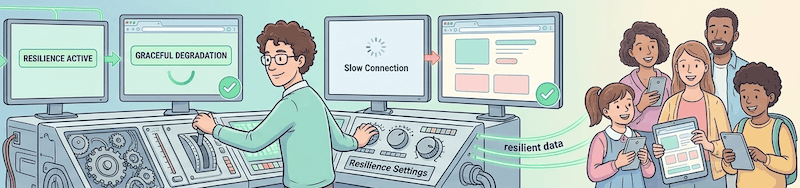
Inget system är perfekt. Servrar går ner, nätverk svajar på pendeln och externa API:er slutar svara. Skillnaden mellan en instabil applikation och en professionell, förtroendeingivande upplevelse ligger sällan i om felen uppstår – utan i hur systemet hanterar dem.
Genom att acceptera att fel är oundvikliga kan vi lättare designa system som aldrig lämnar användaren i ett vakuum. Att integrera detta perspektiv i utveckling från dag ett höjer inte bara den tekniska kvaliteten - det bygger den typ av tillit som krävs för att behålla användare när tekniken sviker.
Begreppet resiliens är ett brett ämne och en systemisk egenskap som spänner över hela stacken – från databaser och mikrotjänster till lastbalanserare och infrastruktur. I det här inlägget kommer vi dock fokusera specifikt på vad man bör tänka på för frontend-delen av en lösning.
Don’t use AI as a robot to solve problems with code; by robot I mean someone who just follows instructions and does exactly as told. There is no AI agent that behaves like that, as there is no human either. Just stop micromanaging your agents and invite them to solve problems together with you.

AI coding assistants are powerful out of the box, but they have no memory of how you prefer to work. Every new conversation starts from zero. You explain your conventions, your preferred tech stack, your testing approach, and then you do it all over again next time. Skills attempt to solve this by letting you store reusable instructions that your assistant can draw on automatically.

Recently, a proposal for adding low-level SIMD support to Go was “Accepted” and was added to Go 1.26 as a GOEXPERIMENT. In the last part I applied a more genuine and fully SIMD-ish approach to my dear ray-sphere intersections, producing results almost 4x faster than the corresponding scalar code. In this part, I’ll try to take advantage of the addition of ToBits Mask32x8 methods to the archsimd package included in Go 1.26.

In this post, I’ll compare five European cloud providers: Scaleway, OVHcloud, Exoscale, CYSO, and Hetzner, with AWS as a counterpoint, representing the non-European hyper-scalers. I’ll look at performance, price, ease of use, and overall experience. Maybe it’s time to leave the big three behind, and look at what Europe has to offer when it comes to the cloud.

Java 25 was released in September 2025 but the rampdown phase for Java 26 has already begun and it will be generally available in the middle of March 2026.
But how much can actually happen in 6 months? Let me tell you.
During the fall, I worked for a Swedish government organisation that has a large legacy codebase. This is a summary of the findings and ways of working that emerged during the project.

Kotlin Coroutines have become the standard for asynchronous programming in the Kotlin ecosystem. While I might not reach for them in every single task, they remain one of the most powerful tools in my developer toolbox. However, using them effectively requires more than just knowing syntax, it requires understanding the underlying mechanics of concurrency.
Recently, a proposal for adding low-level SIMD support to Go was “Accepted” and will be included in Go 1.26 as a GOEXPERIMENT. In the last part I took a look at “thinking in SIMD” in regard to structuring data for SIMD use. In this part, we’ll become more practical, looking at converting a scalar ray-intersection function for data parallelism.
Recently, a proposal for adding low-level SIMD support to Go was “Accepted”. In the last part took a look at SIMD for dot product computations in order to speed up ray-sphere intersection testing. In this blog post, it’s time to “think in SIMD” to hopefully make better use of SIMD.

This is the third and final part of my blog series The black t-shirt architect. Thus far in this series we have concluded that there are no perfect solutions in part 1 so that any architectural decisions becomes a trade-off. We followed up by looking at a way to document architectural decisions in a clear and concise way in part 2. It is finally time for Evolution is inevitable in which we look at how we can balance the need for up-front design without falling into the trap of overengineering the solution.
This is the continuation of my blog series The black t-shirt architect, a name I hope brings to mind the image of an architect still deeply involved in the nitty-gritty details of software development. In this blog series we take a closer look at three fundamental rules of software architecture: Everything is a trade-off, The ‘why’ is more important than the ‘how’ and finally Evolution is inevitable. In the first part we saw how it is essential to consider different alternatives when making significant design decisions and in this part we will follow up by looking at why documenting those design decisions is so important.
This is a new blog series (and my first!) that I have christened The black t-shirt architect. I chose this title to conjure an image of an architect with a background as senior developer still very much involved in the code. I hope it also represents the mindset of a constant learner. Also, I think it sounds rather cool.